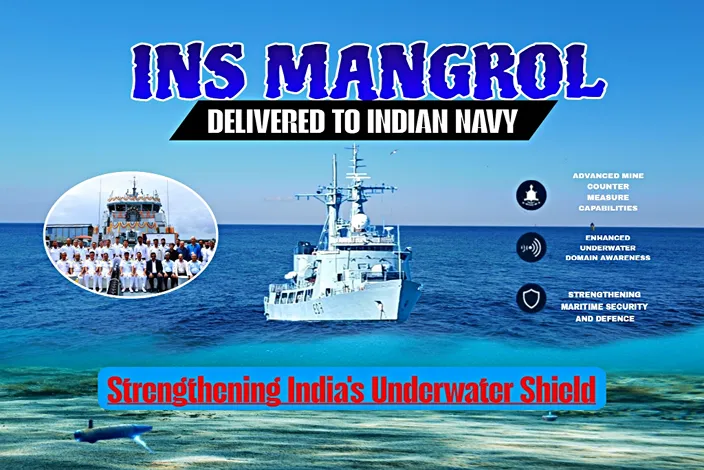

The INS Mangrol delivery gives India another specialised tool for a difficult maritime battlefield: shallow coastal waters. These waters can complicate submarine detection while increasing risks around ports, shipping routes and naval facilities. Cochin Shipyard Limited (CSL) delivered Mangrol to the Indian Navy on 21 August 2026.
It is the third of eight indigenously designed and built Anti-Submarine Warfare Shallow Water Craft. The vessel has been designed for coastal anti-submarine warfare, underwater surveillance and mine-laying. It can also support search-and-rescue missions and low-intensity maritime operations.
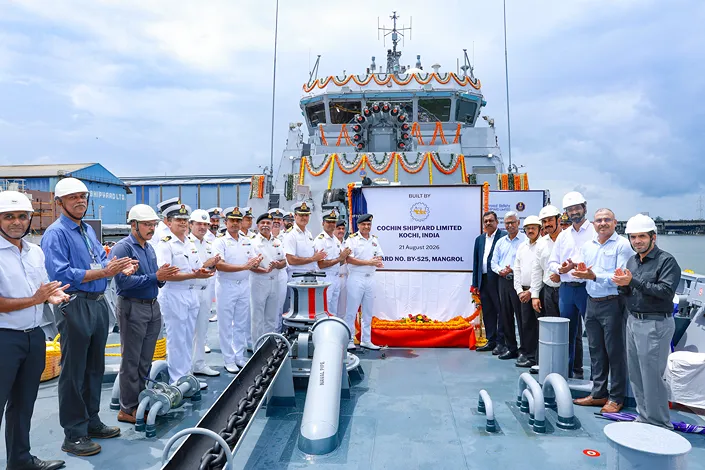
Credit: Cochin Shipyard Limited
What Is INS Mangrol and How Does It Counter
Underwater Threats?
Mangrol belongs to a specialised class of vessels designed for operations close to the coastline. Unlike larger warships, these platforms are built to operate effectively in constrained maritime environments, where submarine detection can be more challenging. The ship was designed and constructed by Cochin Shipyard Limited (CSL) in Kochi and built according to the classification rules of Det Norske Veritas (DNV). The name Mangrol comes from the historic coastal township of Mangrol in Gujarat. This follows the Indian Navy’s tradition of connecting warship names with India’s maritime heritage. However, Mangrol’s importance goes beyond its name or construction. It adds a specialised layer to India’s underwater security network rather than replacing larger surface combatants.
Its main strength lies in shallow-water anti-submarine warfare. Mangrol is equipped with advanced shallow-water sonars designed to detect underwater threats. These systems form the foundation of its anti-submarine warfare role, allowing the vessel to monitor and track submarines in complex coastal waters. Once a threat is detected, the vessel can employ lightweight torpedoes and indigenous anti-submarine rockets. It also has mine-laying capability, giving Mangrol a broader role in underwater security and coastal defence.
Furthermore, the ship uses a Diesel Engine–Waterjet Propulsion system. This arrangement supports high manoeuvrability in confined waters, where conventional larger warships can face greater operational constraints. As a result, Mangrol can respond quickly in shallow coastal environments while supporting India’s wider network of naval surveillance and anti-submarine assets.
Why Shallow-Water ASW Matters for India’s Coastal Security
Submarines are difficult targets even in open seas. However, shallow waters create additional complications for sonar-based detection. Seabed conditions, temperature variations and coastal traffic can make underwater tracking more challenging. Consequently, specialised platforms such as Mangrol are needed near harbours, coastlines and critical maritime infrastructure. The INS Mangrol therefore means more than simply adding another vessel to the Indian Navy.
The craft expands the Navy’s ability to maintain an underwater watch closer to India’s shores. Moreover, it can operate alongside larger warships, submarines and maritime surveillance assets as part of a layered security network. This approach is particularly important for India because its coastline includes major ports, shipping routes and strategically important offshore infrastructure. As maritime activity grows across the Indian Ocean, these areas could face increasingly complex underwater threats.
At the same time, every coastal mission does not require a large warship. Smaller specialised platforms can provide focused surveillance and harbour protection with greater flexibility. Therefore, Mangrol can handle shallow-water missions while larger naval assets remain available for wider deployments. The INS Mangrol delivery ultimately strengthens a layered approach to India’s maritime security. Its value will depend not only on its individual capabilities, but also on how effectively it operates alongside the Navy’s wider surveillance and anti-submarine warfare network.
How INS Mangrol Advances India’s Naval Strategy and Aatmanirbhar Bharat
The INS Mangrol delivery highlights both India’s growing shallow-water warfare capability and its push for indigenous naval shipbuilding. The vessel was indigenously designed and constructed by Cochin Shipyard Limited, supporting the country’s broader Aatmanirbhar Bharat objective. According to available programme information, Mangrol has approximately 80% indigenous content. This reflects the growing role of Indian suppliers in developing sophisticated naval platforms. Importantly, naval self-reliance involves more than building the hull. It also covers sensors, weapons, propulsion systems and specialised engineering expertise.
The programme can therefore strengthen India’s wider defence-industrial ecosystem. It can also provide valuable experience for future indigenous warship projects. At the same time, Mangrol is part of a broader expansion of India’s specialised underwater warfare capabilities. The INS Mangrol delivery follows the commissioning of INS Malvan, the second Mahe-class Anti-Submarine Warfare Shallow Water Craft.
Meanwhile, the eight-ship programme continues to progress at Cochin Shipyard. The seventh vessel, Machilipatnam, was launched by Cochin Shipyard Limited in July 2026 as part of the eight-vessel Mahe-class ASW Shallow Water Craft programme. This indicates that shallow-water anti-submarine warfare is being treated as a long-term naval requirement. As more vessels enter service, India could gain wider coverage across its eastern and western maritime approaches. Thus, Mangrol represents not only another naval asset, but also a step toward a larger indigenous fleet designed for India’s evolving coastal-security needs.
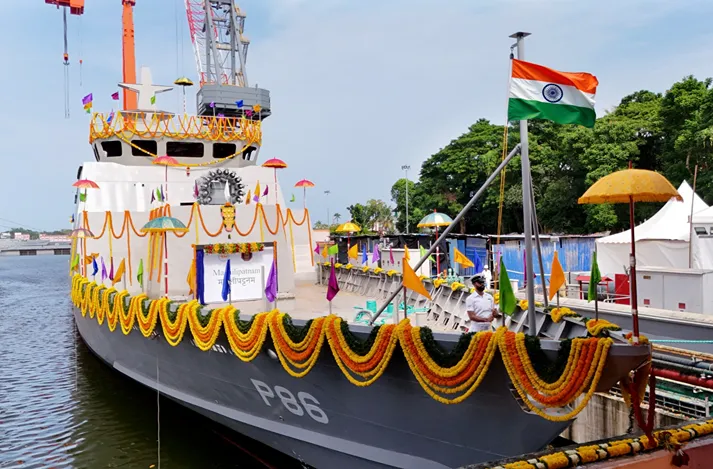
Credit: PIB
Mangrol’s Geopolitical Value and Strategic Limitations
India’s underwater-security concerns are closely linked to developments across the Indian Ocean. Several regional navies are expanding their submarine fleets and strengthening undersea capabilities. Consequently, India needs better ways to monitor approaches to its coastline. The INS Mangrol contributes to that effort without requiring every mission to involve a major warship.
The broader strategy is based on layered maritime deterrence. India is developing capabilities across different ranges, environments and threat levels. This approach could become increasingly important as strategic competition in the Indian Ocean intensifies. However, Mangrol also has clear operational limitations. It is primarily a shallow-water platform rather than a long-range ocean-going combatant. Its effectiveness will therefore depend on the wider surveillance network supporting it.
Sonar performance can also be affected by complex coastal conditions and underwater noise. Furthermore, submarine detection rarely depends on a single sensor or vessel. Aircraft, helicopters, larger warships, fixed sensors and intelligence systems can all contribute to the process. Therefore, the strategic value of the INS Mangrol delivery will ultimately depend on integration. If effectively connected with India’s broader surveillance and anti-submarine warfare network, Mangrol can become an important layer of coastal defence. However, it should be viewed as part of a wider maritime strategy, rather than a standalone solution.
Why INS Mangrol Matters for India’s Future Coastal Defence
The INS Mangrol delivery represents more than another addition to the Indian Navy. It reflects a deliberate effort to strengthen the maritime-security layer closest to India’s shores. Its shallow-water sonar, torpedoes, anti-submarine rockets and manoeuvrability provide specialised capabilities. At the same time, its indigenous construction supports India’s long-term defence manufacturing ambitions.
The vessel arrives as India’s maritime-security priorities continue to expand. Coastal waters are becoming increasingly important as trade, critical infrastructure and naval competition grow across the Indian Ocean. However, Mangrol cannot address every underwater-security challenge by itself. Its real value will depend on how effectively it operates with naval aviation, surface ships and wider surveillance systems.
If the remaining vessels are integrated into this broader network, their collective impact could become significant. Together, they could strengthen the gap between coastal surveillance and larger anti-submarine warfare platforms. The INS Mangrol delivery therefore points toward a broader strategic opportunity. India is building a layered underwater-security network rather than relying on individual platforms.
Ultimately, Mangrol’s importance lies not in its size, but in its specialised mission. As maritime competition increases, that mission could become increasingly important to India’s coastal defence strategy.
FAQs
What is INS Mangrol?
INS Mangrol is an Anti-Submarine Warfare Shallow Water Craft built by Cochin Shipyard Limited. It is designed primarily for underwater surveillance and anti-submarine operations in coastal waters.
When was INS Mangrol delivered?
Mangrol was delivered to the Indian Navy on 21 August 2026 at Cochin Shipyard in Kochi.
What weapons does Mangrol carry?
The vessel carries lightweight torpedoes and indigenous anti-submarine rockets. It is also equipped with advanced shallow-water sonar and mine-laying capability.
Why is shallow-water ASW important for India?
Shallow coastal waters can make submarine detection particularly difficult. Specialised ASW craft can therefore strengthen surveillance around ports, coastlines and other sensitive maritime areas.
How does Mangrol support Aatmanirbhar Bharat?
Mangrol was indigenously designed and constructed by Cochin Shipyard Limited. Its reported indigenous content is approximately 80%, supporting India’s domestic naval manufacturing ecosystem.