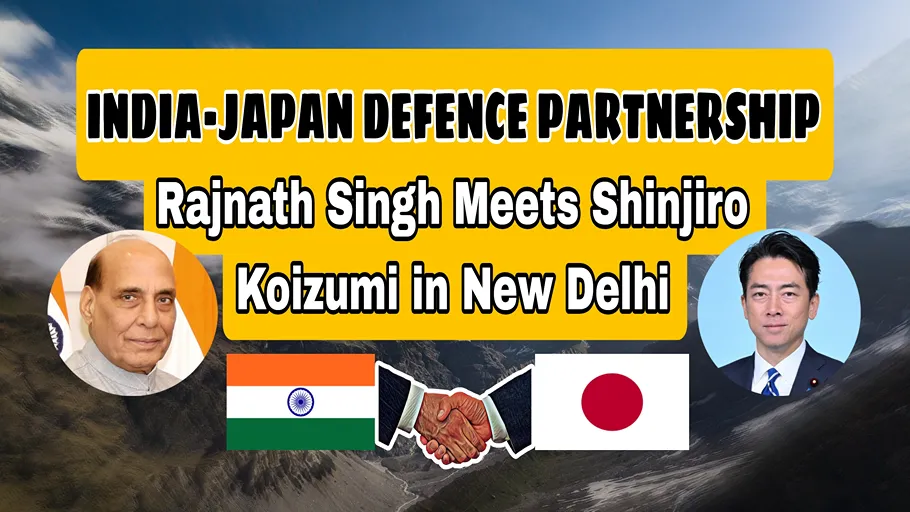

Rajnath Singh–Japan Defence Minister Talks: A Strategic Push for the Indo-Pacific
India and Japan are preparing to give their defence partnership another high-level push as Defence Minister Rajnath Singh is set to hold bilateral talks with Japanese Defence Minister Shinjiro Koizumi in New Delhi on Thursday, August 20. The meeting comes at a time when security calculations across the Indo-Pacific are becoming more complex, making the Rajnath Singh Japan Defence Minister Meeting strategically important for both countries. The talks are expected to focus on strengthening bilateral defence ties, building strategic trust and identifying new areas of cooperation, according to reports ahead of the engagement.
The meeting also follows the eighth India-Japan Defence Policy Dialogue held in Tokyo in July, where officials reviewed military exchanges, maritime cooperation, exercises, capacity building, defence equipment and technology cooperation. Japan had also indicated interest in advancing cooperation involving its UNICORN communication antenna system. The Rajnath Singh Japan Defence Minister Meeting therefore comes as part of a broader process rather than an isolated diplomatic event. It reflects the steady institutionalisation of defence relations between New Delhi and Tokyo under their Special Strategic and Global Partnership. Both sides have repeatedly supported a free, open and rules-based Indo-Pacific, while seeking practical cooperation that can improve regional resilience.
The Rajnath Singh Japan Defence Minister Meeting is also significant because Japan’s defence minister is visiting India amid wider consultations with regional partners. For New Delhi, the engagement provides an opportunity to expand defence-industrial links, maritime coordination and technology partnerships. For Tokyo, deeper cooperation with India can strengthen its network of trusted partners in the Indo-Pacific. The Rajnath Singh Japan Defence Minister Meeting is thus likely to be watched not only for immediate announcements, but also for signals about the future direction of India-Japan strategic cooperation and the practical mechanisms both governments can use to turn political understanding into sustained defence action.
- Banking for Youth: Sitharaman Calls for Month-Long PSB Campaign From October 2
- Ayush Shetty Stuns World No. 1 Shi Yuqi: India’s New Badminton Star Rises
- India’s Dog Bite Cases Reveal a Growing Public-Health Challenge
- India’s Wars and Border Conflicts: The Two-Front Challenge
- India vs China: 5 Turning Points That Changed the Himalayan Border Forever
Main Issues on the India-Japan Defence Agenda
The main agenda of the Rajnath Singh Japan Defence Minister Meeting is expected to centre on practical defence cooperation, regional security and the next stage of the India-Japan strategic partnership. Defence equipment and technology cooperation will remain a major area of discussion. Japan’s revised defence equipment transfer framework has created additional scope for collaboration, while Japanese officials have indicated expectations that cooperation involving the UNICORN communication antenna system will move forward. The Rajnath Singh Japan Defence Minister Meeting could therefore help convert earlier policy decisions into concrete projects and identify new areas where Indian and Japanese technologies can complement each other.
Maritime security is another important pillar of the Rajnath Singh Japan Defence Minister Meeting. India and Japan are major Indo-Pacific maritime powers, with shared interests in protecting sea lanes, maintaining resilient supply chains and upholding international law. Greater naval cooperation, information sharing and joint exercises can improve coordination during security contingencies as well as humanitarian and disaster-relief operations. For both countries, stronger maritime coordination can also contribute to greater stability across the Indian Ocean and wider Indo-Pacific region.
The Rajnath Singh Japan Defence Minister Meeting is also expected to examine military-to-military exchanges, joint exercises and institutional interactions. Such engagements are important because defence partnerships become more effective when military personnel develop operational familiarity and communication channels before a crisis occurs. Regular exchanges can improve mutual understanding, strengthen interoperability and create greater confidence between the armed forces of both countries. These efforts could also expand cooperation in training, capacity building and defence education, giving the partnership a stronger institutional foundation.
Emerging technologies are likely to provide another significant dimension to the Rajnath Singh Japan Defence Minister Meeting. Cybersecurity, space, artificial intelligence, advanced communications, autonomous systems and defence manufacturing are becoming increasingly important to national security. The July Defence Policy Dialogue had already reviewed several areas of bilateral defence engagement, creating a policy foundation for ministerial-level discussions. India and Japan can use this momentum to encourage research partnerships, technology development and industrial collaboration, potentially creating opportunities for companies and research institutions in both countries.
Ultimately, the Rajnath Singh Japan Defence Minister Meeting can reinforce the shared strategic vision of India and Japan for a free, open and rules-based Indo-Pacific. However, the real measure of success will be the implementation that follows the talks. Clear timelines, new projects, deeper exercises, technology cooperation and regular institutional reviews would give the partnership greater momentum. The meeting could therefore become an important step in transforming India-Japan defence cooperation from broad strategic understanding into practical and long-term capabilities, while strengthening trust between two key Indo-Pacific partners.
How the Meeting Can Strengthen India-Japan Relations
The broader significance of the Rajnath Singh Japan Defence Minister Meeting lies in how it can strengthen a relationship that has steadily expanded from political dialogue into operational and industrial cooperation. India and Japan upgraded their relationship to a Special Strategic and Global Partnership in 2014, and defence has become one of its central pillars. Ministerial meetings, the 2+2 format, defence policy dialogues, military exchanges and joint exercises have created multiple channels for regular communication. The Rajnath Singh Japan Defence Minister Meeting adds another important layer to this architecture by keeping political leadership directly engaged on emerging security priorities.
For India, the Rajnath Singh Japan Defence Minister Meeting can support the modernization of its armed forces through access to advanced technologies, industrial partnerships and new defence manufacturing opportunities. Japan, meanwhile, gains from working with a major regional power that has extensive experience across the Indian Ocean, as well as growing capabilities in maritime operations, space and defence production. The meeting can also encourage both countries to identify areas where their technological and industrial strengths complement each other, potentially creating long-term opportunities for joint development, manufacturing and research.
The Rajnath Singh Japan Defence Minister Meeting can also strengthen strategic confidence between the two governments at a time when both countries are responding to changing security conditions across the Indo-Pacific. Cooperation does not mean India and Japan will adopt identical security policies. Instead, their partnership can provide greater interoperability, consultation and resilience while allowing both countries to preserve their strategic autonomy. This distinction is particularly important for India, which maintains relationships with multiple major powers and generally prefers strategic partnerships rather than formal military alliances.
Another important dimension of the Rajnath Singh Japan Defence Minister Meeting is its potential economic impact. Stronger defence cooperation can encourage Japanese investment, Indian manufacturing partnerships, technology transfers, research collaboration and supply-chain integration. If proposed projects move beyond announcements and into actual production, the benefits could extend well beyond defence ministries. Technology companies, shipyards, electronics manufacturers, engineering firms and research institutions could all gain from a deeper India-Japan industrial relationship. Such cooperation could also contribute to India’s broader ambition of strengthening domestic defence manufacturing.
Ultimately, the Rajnath Singh Japan Defence Minister Meeting could become a significant step toward a more balanced India-Japan partnership combining security, technology and industrial capability. It can deepen trust without requiring a formal alliance structure and create stronger mechanisms for responding to future regional challenges. As both countries seek a free, open and stable Indo-Pacific, closer defence coordination can provide practical benefits while reinforcing their wider strategic partnership. The Rajnath Singh Japan Defence Minister Meeting therefore has significance far beyond a single ministerial engagement, with the potential to shape cooperation for years to come.
What India and Japan Stand to Gain
For both countries, the Rajnath Singh Japan Defence Minister Meeting could deliver benefits across security, technology, industry and diplomacy if New Delhi and Tokyo maintain momentum after the talks. Defence forces could gain from more frequent exercises, professional exchanges and better coordination in maritime surveillance and disaster response. A stronger operational relationship would also improve mutual understanding between the two militaries and create greater preparedness for emerging regional challenges.
The Rajnath Singh Japan Defence Minister Meeting could also open new opportunities for defence manufacturers and technology companies. Equipment and technology cooperation may support joint development, licensed production and stronger supply-chain partnerships. Indian companies seeking advanced components and Japanese firms looking for reliable manufacturing partners could benefit from deeper industrial cooperation. This could strengthen India’s defence manufacturing ambitions while giving Japanese companies access to India’s expanding defence ecosystem.
Another important area for the Rajnath Singh Japan Defence Minister Meeting is emerging technology. Both countries have an interest in expanding cooperation in cybersecurity, autonomous systems, space-based capabilities, secure communications and artificial intelligence. These sectors are increasingly linked to national security as well as economic competitiveness. Greater collaboration could encourage research partnerships, technology exchanges and innovation while helping India and Japan prepare for the changing nature of modern warfare.
The diplomatic importance of the Rajnath Singh Japan Defence Minister Meeting is equally significant. A stronger India-Japan defence relationship gives both countries another platform to consult on developments across the Indo-Pacific and support a regional order based on international law and peaceful dispute settlement. The partnership can also improve strategic coordination without requiring either country to abandon its policy of strategic autonomy. This makes the relationship valuable at a time of growing geopolitical uncertainty.
Ultimately, the success of the Rajnath Singh Japan Defence Minister Meeting should be judged by what follows after the cameras leave. The most meaningful outcome would be a clear implementation pathway for projects already discussed, regular senior-level reviews and measurable progress in exercises, technology transfer and industrial collaboration. The July 2026 Defence Policy Dialogue already covered several areas of cooperation, while Japan’s Defence Ministry indicated that both sides would strengthen coordination. The Rajnath Singh Japan Defence Minister Meeting can build on this foundation, making the partnership more predictable, improving defence readiness, creating commercial opportunities and giving both governments stronger tools to manage future regional security challenges together.
What is the Rajnath Singh Japan Defence Minister Meeting?
It is a high-level bilateral defence engagement between India’s Rajnath Singh and Japan’s Shinjiro Koizumi.
What are the main issues?
Defence equipment, technology, maritime security, exercises, regional security and Indo-Pacific cooperation.
Why is Japan important to India?
Japan is a major Indo-Pacific partner with advanced technology, industrial capacity and a shared interest in regional stability.
Will this create a military alliance?
Not necessarily. India-Japan defence cooperation is designed to deepen strategic coordination while both countries retain strategic autonomy.
By Sahil Koul | National Affairs Analyst covering Indian politics, governance, public policy, and major developments shaping the nation.