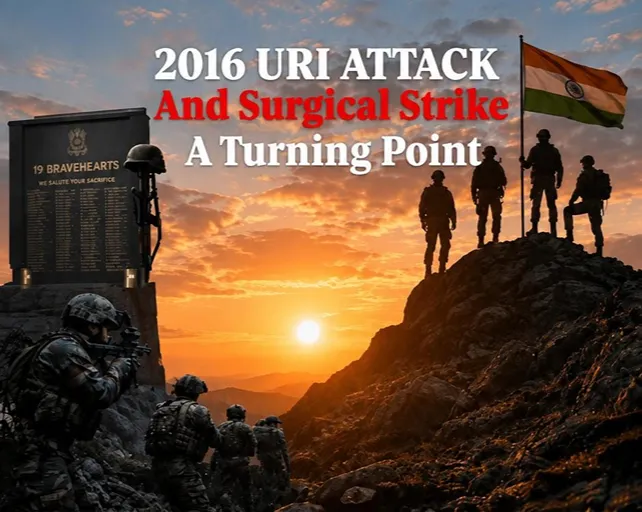

The 2016 Uri attack marked a major turning point in India’s counter-terrorism and national security strategy. On 18 September 2016, militants attacked an Indian Army base in Uri, Jammu and Kashmir, killing 19 soldiers. The attack triggered widespread public anger and intensified pressure on the government to deliver a strong response to cross-border terrorism.
On 29 September, India announced that Army Para Special Forces had carried out a cross-LoC operation against suspected militant launch pads in Pakistan-administered Kashmir. New Delhi described the action as a “surgical strike”, saying it was intended to prevent planned infiltration and terrorist attacks. The operation signalled a greater willingness to use limited military force beyond the LoC.
The operation also transformed the strategic and political conversation between India and Pakistan. India presented the strike as a demonstration of deterrence and calibrated retaliation, while Pakistan rejected the claim of a surgical strike and described the incident as cross-border firing. Therefore, the 2016 episode remains a contested but significant chapter in India-Pakistan relations, with its military details, casualties, and longer-term impact still debated.
2016 Uri Attack and India’s Military Response
The 2016 Uri attack came amid rising infiltration attempts along the Line of Control (LoC). In its statement after the attack, the Indian Army said it had eliminated 17 infiltration bids in 2016, while 31 of the 110 terrorists killed in Jammu and Kashmir had been neutralised while attempting to cross the LoC. The Army also reported that four militants were killed during an infiltration attempt in Poonch on 11 September and another four during the Uri operation on 18 September.
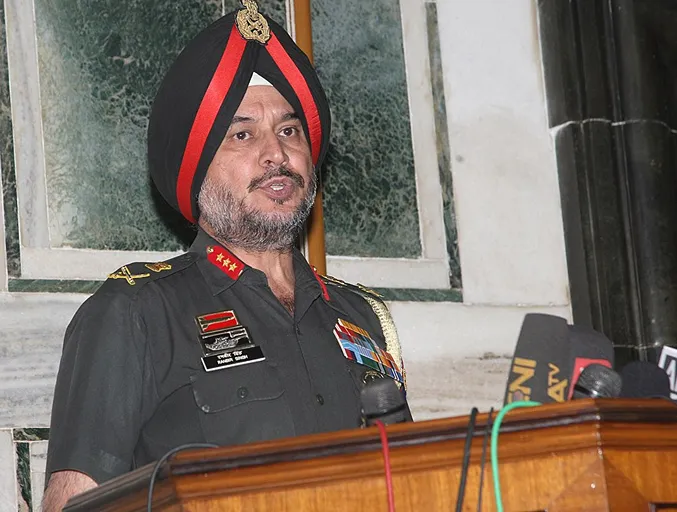
credit: Wikimedia commons
On 18 September 2016, four heavily armed militants attacked an Indian Army base near Uri. All four attackers were killed, while 19 Indian soldiers lost their lives. The Army said weapons and equipment recovered from the attackers included four AK-47 rifles, four under-barrel grenade launchers, 39 grenades, five hand grenades, two radio sets, two GPS devices, maps and a mobile phone, along with food and medical supplies carrying Pakistani markings. The attack triggered widespread anger and increased pressure on the government to deliver a stronger response.
The Army had already indicated that it retained the capability to respond to such attacks, saying it reserved the right to act “at a time and place of own choosing.” On 29 September, India announced that its Army had conducted a cross-LoC operation against suspected militant launch pads. India described the action as pre-emptive and linked it to intelligence about planned infiltration, while Pakistan rejected the claim and described the incident as cross-border firing. The broader security environment remained volatile, making the operation an important turning point in India’s counter-terrorism strategy.
| Year | Terrorist Incidents | Security Forces Killed | Civilians Killed | Terrorists Killed |
|---|---|---|---|---|
| 2016 | 322 | 82 | 15 | 150 |
| 2017 | 342 | 80 | 40 | 213 |
| 2018 | 614 | 91 | 39 | 257 |
| 2019 | 594 | 80 | 39 | — |
The data illustrates the continuing human cost of terrorism and armed violence after the 2016 operation. However, the precise losses attributed directly to the surgical strike remain contested because India and Pakistan provided different accounts of the incident.
India-Pakistan Response and Escalation
credit: Wikimedia commons
Pakistan strongly rejected India’s claim that it had conducted a surgical strike across the Line of Control (LoC). Its military described the incident as cross-border firing rather than a deliberate raid on militant launch pads. Islamabad warned that any confirmed cross-LoC operation would represent a serious escalation, while India maintained that its forces had targeted suspected militant infrastructure.
The disagreement soon extended beyond the operation itself. India presented the strike as evidence of its willingness to impose costs on groups preparing attacks, while Pakistan challenged both the nature and significance of the operation. This created competing narratives around the incident, with military claims, casualty figures and operational details remaining disputed between the two sides.
Tensions along the LoC also increased after the strike. Indian government data recorded 228 ceasefire violations in 2016, rising sharply to 860 in 2017. The escalation affected border communities as well, with 27,449 people evacuated from villages in Jammu division in 2016 amid heightened security concerns. These developments showed that the operation did not immediately ease tensions between the two countries.
In India, the surgical strike was widely viewed as a strong response to the Uri attack and a move toward a more proactive counter-terrorism strategy. The government later commemorated the operation through Parakram Parv in 2018, highlighting the role of the armed forces. However, the episode also exposed the risks of escalation between two nuclear-armed neighbours, making deterrence, military preparedness and strategic restraint equally important.
Conclusion
The 2016 Uri attack and India’s subsequent surgical strike became a defining moment in the country’s evolving counter-terrorism strategy. The deadly attack exposed the continuing human cost of militancy and cross-border infiltration, while India’s response signalled a greater willingness to consider limited military action across the LoC.
The significance of the operation became clearer after the 2019 Pulwama attack, when India carried out the Balakot airstrike. Unlike the 2016 ground operation involving Army special forces, Balakot involved the Indian Air Force, showing that India’s military response options had expanded beyond the LoC.
The broader sequence — Uri in 2016, the surgical strike, Pulwama in 2019 and Balakot — reflects a shift from traditional deterrence toward more proactive military signalling. However, it also highlights the risks of escalation between two nuclear-armed neighbours. Nearly a decade later, the 2016 Uri attack remains a key reference point for understanding how India’s response to cross-border terrorism has evolved.
What happened in the 2016 Uri attack?
On 18 September 2016, four militants attacked an Indian Army base near Uri. The attack ultimately killed 19 Indian soldiers.
When did India conduct the surgical strike?
India announced the operation on 29 September 2016. The operation took place during the night of 28–29 September, according to the Indian government.
Which forces conducted the 2016 surgical strike?
The operation was conducted by the Indian Army’s Para (Special Forces). Units commonly associated with the operation include 4 Para and 9 Para.
How many militants were killed in the surgical strike?
India initially described the casualties as significant but did not provide a definitive official number in the DGMO’s announcement. Claims of higher casualty figures circulated later, but exact numbers remain disputed.
Did Pakistan accept India’s surgical-strike claim?
No. Pakistan rejected India’s characterization and said the incident involved cross-border firing rather than a surgical strike.