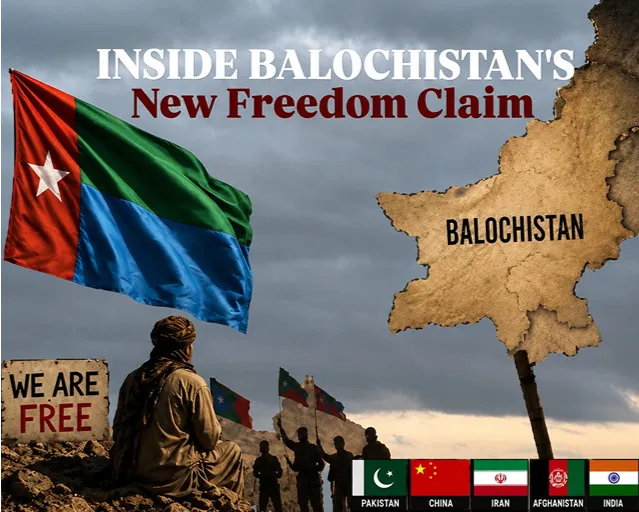

“We are free” is the message being echoed by Baloch nationalist groups this August. Yet behind the powerful slogan lies a far more complex political and geopolitical reality. Balochistan independence remains a contested political claim, not an internationally recognised fact.
On August 11, Baloch nationalist groups and sections of the diaspora marked what they call Balochistan Independence Day. The date carries deep historical significance for supporters of the independence movement and comes just three days before Pakistan celebrates its own Independence Day. The symbolism is striking. But declaring freedom does not, by itself, create a sovereign state. Balochistan remains under Pakistan’s administration, while the independence movement faces significant military, political and diplomatic challenges.
That leaves a crucial question at the heart of the latest campaign: Can a declaration of freedom translate into a genuine geopolitical transformation?
History Behind Balochistan’s Freedom Claim
The roots of the Balochistan independence debate go back to the partition of British India and the disputed accession of the Khanate of Kalat to Pakistan. For Baloch nationalists, the events surrounding 1947–48 remain central to their argument that the region’s political status was never fully resolved. Pakistan, however, considers Balochistan an integral part of the country. Over time, demands for greater autonomy became intertwined with disputes over political representation, resource control, economic development and security operations. Balochistan’s vast territory, mineral wealth and strategic coastline have also made the conflict increasingly important beyond Pakistan’s domestic politics.
| Year / Period | Major development | Significance |
|---|---|---|
| 1947 | Kalat declared independence | Became central to competing claims over Baloch sovereignty |
| 1948 | Kalat acceded to Pakistan; Prince Abdul Karim launched a revolt | First major armed resistance |
| 1958–59 | Second insurgency | Renewed demands for Baloch autonomy |
| 1962–63 | Third insurgency | Further escalation of political and armed resistance |
| 1973–77 | Major Baloch insurgency | One of the conflict’s most intense phases |
| 2003 | Current insurgency began | Marked the beginning of the modern separatist campaign |
| 2026 | Independence campaign gains renewed attention | “Balochistan Independence Day” and new state symbols bring the issue back into focus |
The conflict has therefore evolved through several phases, from disputes over accession to prolonged insurgency and today’s renewed independence campaign. Balochistan is Pakistan’s largest province by area, covering about 347,190 square kilometres, while its reserves of natural gas, copper, gold and coal add significant economic importance. Gwadar further raises its strategic value because of its location and China’s investments under the China-Pakistan Economic Corridor. For Baloch nationalists, these factors strengthen the case for greater control over local resources and political affairs. For Islamabad, separatism remains a threat to territorial integrity.
Balochistan’s New Independence Claim
The Balochistan independence campaign gained attention in July 2026 after the self-proclaimed Republic of Balochistan announced an independence declaration. Its territorial claims remain unverified and have no international recognition. Tensions escalated on August 12, 2026, when reports alleged Pakistani air operations killed 21 civilians, including women and children. The reported strikes were followed by BLA attacks across several districts, although the civilian death toll remains independently unverified.
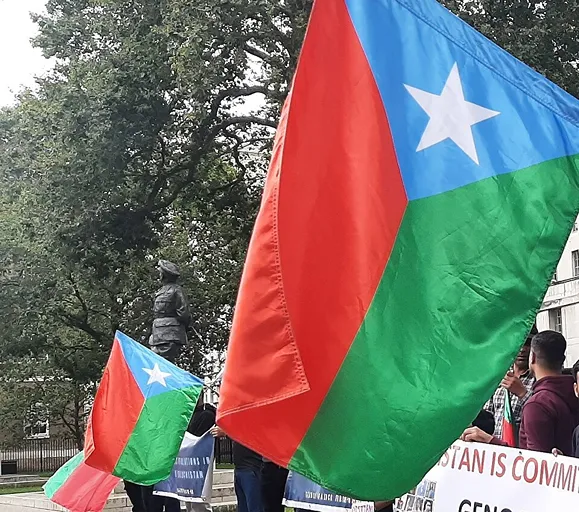
The campaign nevertheless represents a notable shift in the movement’s messaging. Supporters are moving beyond calls for separation and are attempting to project the image of a future independent state with its own identity and institutions. A proposed Balochistan flag has become one of the most visible symbols of this campaign, giving the independence claim a stronger political and visual identity. The reported military operations and subsequent militant attacks, meanwhile, have added another layer to an already volatile conflict, raising fresh questions about civilian safety, Pakistan’s security response and the future direction of the independence movement.
Balochistan’s Freedom Bid Meets Reality
Supporters of Balochistan independence have promoted a proposed national flag, anthem, currency and administrative system, including a currency called the Balochi Falus. These symbols aim to strengthen the image of a future state, but they cannot establish sovereignty without effective institutions, territorial control and international recognition. At the same time, Balochistan’s vast territory, natural resources and Gwadar Port make the province strategically important for Pakistan and regional powers.
The independence campaign is also unfolding amid an active insurgency. In January 2026, the Balochistan Liberation Army launched coordinated attacks across more than a dozen locations, prompting a major Pakistani military operation. According to reporters, Pakistan’s military reported 216 militants killed during the week-long operation, while the BLA disputed the government’s account. The episode highlighted both the insurgency’s growing reach and Islamabad’s willingness to use force, underscoring the difficult gap between declaring independence and establishing political control.
India, China and the Balochistan Question
The biggest challenge for Balochistan independence is international recognition. There is no broad diplomatic support for an independent Balochistan. While some countries may raise concerns about human rights or violence, that does not mean they support separatism. Any independence bid would require effective governance, territorial control, and recognition from other states.
China has major interests in Balochistan through Gwadar Port and the China-Pakistan Economic Corridor (CPEC), where Chinese projects and workers have faced militant attacks. India has criticised Pakistan’s policies in Balochistan but has not recognised an independent Balochistan. Pakistan has accused India of supporting Baloch militants, allegations New Delhi denies. Iran is also closely watching the issue because of its Baloch population and border security concerns. Meanwhile, the US and Gulf states are likely to prioritize regional stability and their strategic ties with Pakistan. Thus, the Balochistan question remains primarily a regional security issue rather than an internationally supported independence movement.
Can Balochistan Really Become Independent?
A declaration alone cannot make Balochistan independence a political reality. Pakistan still maintains significant military and administrative control, while the separatist movement faces questions over political unity, territorial control and international recognition. Neighbouring countries also have their own concerns. Iran, which has a large Baloch population in Sistan and Baluchistan, would be wary of developments that could encourage separatism. Afghanistan’s long border with Pakistani Balochistan adds another layer to the regional security equation.
What Happens Next?
Three possible paths could shape the future. The campaign could remain largely symbolic, gaining attention through protests, social media and diaspora activism without changing control on the ground. Alternatively, a rise in insurgent attacks could trigger a stronger Pakistani military response, potentially reducing militant capabilities while deepening political grievances. A third possibility is greater international attention if violence escalates or human-rights concerns intensify. However, international scrutiny would not automatically translate into diplomatic recognition. Ultimately, the future of the Balochistan independence movement will depend less on declarations and more on territorial control, political legitimacy, governance and international diplomacy.
The broader consequences could extend beyond Pakistan. A prolonged insurgency could increase security costs, threaten Chinese investments around Gwadar and create additional regional instability. At the same time, meaningful political dialogue, economic development and greater local participation could help reduce tensions. For now, however, the central challenge remains the same, turning a powerful freedom claim into a sustainable political reality.
Conclusion
The latest Balochistan independence campaign is politically significant, but it does not mean that a new country has been created. The “We are free” message draws on a deeply contested history and seeks to turn long-standing nationalist sentiment into a broader political movement. The proposed flag and other state symbols give the campaign greater visibility, but symbolism alone cannot establish sovereignty. Effective governance, territorial control, political legitimacy and international recognition remain essential. For now, Balochistan remains part of Pakistan, and the crucial question is what follows the declarations.
If the movement gains wider support, international attention could grow. If violence intensifies, Islamabad may respond with greater security pressure. The outcome will ultimately depend not only on Baloch nationalist groups, but also on Pakistan, China, Iran, Afghanistan and the wider international community. For now, Balochistan’s freedom claim remains a powerful political message, but its transformation into an independent state remains uncertain.
Is Balochistan an independent country?
No. Balochistan remains a province administered by Pakistan. Recent independence declarations have not received international recognition.
Why do Baloch nationalists celebrate August 11?
Baloch nationalist groups associate August 11 with the 1947 independence declaration of the Khanate of Kalat. They use the date to promote their historical claim to sovereignty.
Does Balochistan have its own flag?
Baloch nationalist groups have promoted proposed flags for an independent Balochistan. These symbols represent the independence movement rather than an internationally recognised state.
What caused the Balochistan conflict?
The conflict has multiple causes. They include disputes over political autonomy, resource distribution, economic grievances and allegations of human-rights abuses. Armed separatist movements have also played a major role.
Could Balochistan become an independent country?
It is possible in theory, but major political, military and diplomatic barriers remain. International recognition and effective governance would be essential.