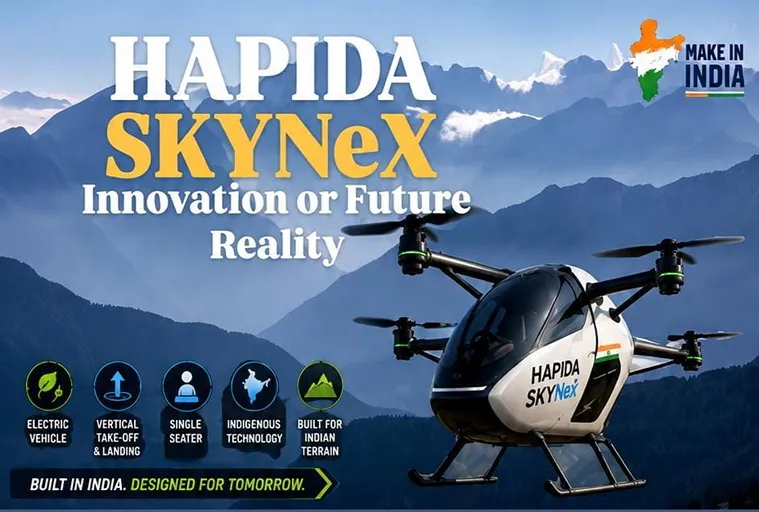

HAPIDA SKYNeX is an indigenous personal flying vehicle prototype developed by Ravi Tamta, founder and CEO of Hapida Sky Private Limited, based in Almora, Uttarakhand. The project has gained national attention after completing its maiden test flight, positioning itself among India’s earliest privately developed personal air mobility initiatives. Designed as a single-seater electric vehicle, it combines multi-rotor drone technology with electric propulsion to achieve vertical take-off and landing (eVTOL). The project reflects the growing capabilities of Indian startups in advanced aviation and aligns with the broader vision of promoting innovation under the Make in India initiative.
Unlike conventional helicopters or fixed-wing aircraft, HAPIDA SKYNeX is being developed as a compact mobility solution for short-distance travel. The long-term vision is to provide a cleaner, quieter, and more efficient mode of transportation, particularly for urban areas and remote regions where road connectivity remains challenging. Although the prototype is still undergoing research and testing, it represents an important milestone in India’s efforts to develop indigenous aerospace technologies.
What Is HAPIDA SKYNeX?
HAPIDA SKYNeX is a prototype electric vertical take-off and landing (eVTOL) vehicle created to explore the future of personal aerial transportation in India. It is designed to lift off and land vertically using multiple electric rotors, eliminating the need for conventional runways. This concept belongs to the emerging field of Advanced Air Mobility (AAM), where electric aircraft are expected to provide faster and more sustainable transportation for short distances.
The prototype is based on an enhanced version of multi-rotor drone technology and has been engineered as a single-seat flying vehicle. Rather than competing with commercial aircraft, HAPIDA SKYNeX is intended to demonstrate how compact electric aircraft could eventually improve personal mobility, emergency response, and connectivity in difficult terrain. While the technology is still experimental, its successful maiden flight marks an important proof of concept for India’s growing electric aviation sector.
Who Invented HAPIDA SKYNeX?
HAPIDA SKYNeX was developed by Ravi Tamta, a young innovator from Almora, Uttarakhand, and founder of Hapida Sky Private Limited, with the vision of creating indigenous aerial mobility solutions. Inspired by advances in drone technology and electric aviation, Tamta spent several years researching, designing, and testing the prototype to develop a safe and sustainable personal flying vehicle.
The project gained nationwide attention after completing its maiden test flight on 6 August 2026 in Almora. The demonstration marked an important milestone for India’s emerging electric aviation sector. Rather than relying on imported technology, HAPIDA SKYNeX showcases homegrown engineering and innovation, highlighting the growing potential of Indian startups to contribute to the rapidly evolving field of advanced air mobility.
Why HAPIDA SKYNeX Matters
HAPIDA SKYNeX was developed with the goal of creating a safe, electric, and environmentally friendly personal flying vehicle that could transform short-distance transportation in India. Unlike conventional aircraft, the prototype focuses on individual air mobility and aims to reduce travel time in congested cities as well as geographically challenging regions such as Uttarakhand. In the future, the technology could also support emergency medical services, disaster response, tourism, surveillance, and improved connectivity in remote areas, while strengthening India’s capabilities in electric aviation under the Make in India initiative.
The project has attracted widespread attention because it is regarded as one of India’s first privately developed indigenous personal flying vehicle prototypes. Although the country has made significant advances in drones and aerospace technology, personal electric flying vehicles remain a relatively unexplored field. Developed by a startup in Uttarakhand, HAPIDA SKYNeX demonstrates how local innovation can contribute to the emerging Advanced Air Mobility (AAM) sector and reduce dependence on imported technologies.
However, HAPIDA SKYNeX is still an experimental prototype, not a commercially certified aircraft. It has successfully demonstrated the feasibility of its core technology, but extensive flight testing, safety validation, and regulatory approvals will be required before it can enter commercial service. Even so, the project marks an important milestone in India’s journey toward next-generation personal air mobility and indigenous aerospace innovation.
HAPIDA SKYNeX: Features & Challenges
HAPIDA SKYNeX is designed as a single-seater electric vertical take-off and landing (eVTOL) prototype that showcases India’s growing capabilities in personal air mobility. Developed by Hapida Sky Private Limited, it uses electric propulsion to enable cleaner and quieter flight while eliminating the need for conventional runways. The project also highlights indigenous aerospace innovation and could support future applications such as personal transportation, emergency response, and improved connectivity in remote areas.
However, the prototype is still in the testing phase. Limited battery range, regulatory approvals, supporting infrastructure, and high development costs remain the biggest challenges before HAPIDA SKYNeX can become commercially viable.
HAPIDA SKYNeX at a Glance
| Feature | Details |
|---|---|
| Vehicle Type | Single-seater eVTOL prototype |
| Power Source | Electric propulsion |
| Take-off | Vertical take-off and landing (VTOL) |
| Developer | Hapida Sky Private Limited |
| Key Advantage | Eco-friendly, indigenous technology |
| Potential Uses | Personal mobility, emergency services, tourism |
| Major Challenges | Battery life, certification, infrastructure, weather |
Conclusion
HAPIDA SKYNeX represents a significant milestone in India’s journey toward next-generation personal air mobility. Although it is still an experimental prototype, its successful maiden test flight highlights the growing capabilities of Indian innovators in developing advanced electric aviation technologies. Developed by Ravi Tamta and Hapida Sky Private Limited, the project demonstrates how homegrown startups are beginning to explore technologies that could transform future transportation.
While commercial operations remain some years away, HAPIDA SKYNeX has already established itself as one of India’s earliest indigenous personal flying vehicle initiatives. Continued research, regulatory approvals, infrastructure development, and investment will determine its future success. If these challenges are addressed, the project could play an important role in advancing sustainable aviation and strengthening India’s position in the global advanced air mobility sector.
1. What is HAPIDA SKYNeX?
HAPIDA SKYNeX is an indigenous single-seater electric flying vehicle (eVTOL) prototype developed by Hapida Sky Private Limited to explore personal air mobility in India.
2. Who invented HAPIDA SKYNeX?
The project was developed by Ravi Tamta, founder and CEO of Hapida Sky Private Limited, based in Almora, Uttarakhand.
3. Why is HAPIDA SKYNeX considered a first technology?
It is regarded as one of India’s first privately developed indigenous personal flying vehicle prototypes, demonstrating the country’s growing capabilities in electric aviation.
4. What are the main features of HAPIDA SKYNeX?
Its key features include electric propulsion, vertical take-off and landing (eVTOL), a single-seater design, indigenous engineering, and potential applications in personal transportation and emergency services.
5. Is HAPIDA SKYNeX ready for commercial use?
No. HAPIDA SKYNeX is still an experimental prototype. It requires further testing, safety validation, and regulatory certification before it can be considered for commercial operations.