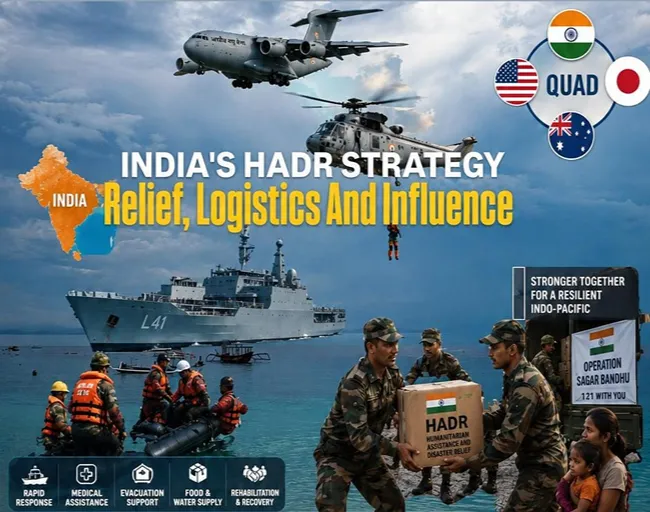

When disaster strikes across the Indian Ocean, India is increasingly expected to do more than deliver emergency supplies. Its armed forces can rapidly deploy naval ships, aircraft, medical teams and engineering units to affected areas. This growing capability is turning HADR into an important pillar of India’s regional diplomacy.
India’s Humanitarian Assistance and Disaster Relief (HADR) capabilities have evolved significantly since the 2004 Indian Ocean tsunami. Today, its response framework combines military logistics, evacuation missions, medical assistance, search and rescue, maritime surveillance and international coordination. The Indian Army, Navy, Air Force and Coast Guard each play a crucial role in these operations.
The shift comes as natural disasters become a recurring challenge across the Indo-Pacific. For India, therefore, disaster response is no longer limited to saving lives and delivering relief. It is increasingly about building regional trust, strengthening strategic partnerships and establishing India as a reliable first responder and security partner across the Indo-Pacific.
India’s HADR Reach Across the Indo-Pacific
India’s HADR capabilities have expanded significantly since the 2004 Indian Ocean tsunami, which became a major turning point in the country’s approach to disaster response. Since then, the armed forces have developed greater capacity for rescue operations, evacuations, medical assistance, engineering support and large-scale relief missions.
The scale of recent deployments highlights this transformation. In 2025, Indian Army HADR teams operated across more than 80 locations in 10 states, while rescuing thousands of civilians and providing medical assistance during emergencies.
| HADR Indicator | Reported Figure |
|---|---|
| Indian Army HADR deployments in 2025 | 141 columns |
| Locations covered | 80+ |
| States covered | 10 |
| Civilians rescued | 28,293 |
| People provided medical aid | 7,318 |
| Operation Brahma field hospital | 60 beds |
| Myanmar earthquake patients treated | 2,500+ |
| HADR material sent to Myanmar | 750 tonnes |
| Sri Lanka relief under Operation Sagar Bandhu | 1,058 tonnes |
| People evacuated from Sri Lanka | 2,500+ |
India’s experience also extends beyond its borders. During Operation Brahma following Myanmar’s March 2025 earthquake, Indian forces combined medical, airlift and naval capabilities to provide emergency assistance. Operation Sagar Bandhu later demonstrated a similar multi-service approach during the crisis in Sri Lanka.
The wider Indo-Pacific makes this capability increasingly important. The region contains densely populated coastlines, vulnerable island nations and critical maritime routes that face cyclones, earthquakes, tsunamis and floods. Disasters can quickly damage transport infrastructure and isolate affected communities.
India’s geographic position at the centre of the Indian Ocean gives it a natural advantage in responding to such emergencies. Its ports, airfields and naval facilities can support rapid deployments across the region. Meanwhile, exercises with countries such as the Maldives help improve coordination in search and rescue, medical assistance and disaster logistics.
This combination of geography, operational experience and regional partnerships is strengthening India’s position as a first responder. More importantly, regular HADR exercises allow countries to establish communication channels and procedures before a real crisis occurs, making future responses faster and more coordinated.
Quad HADR and the Indo-Pacific Logistics Network
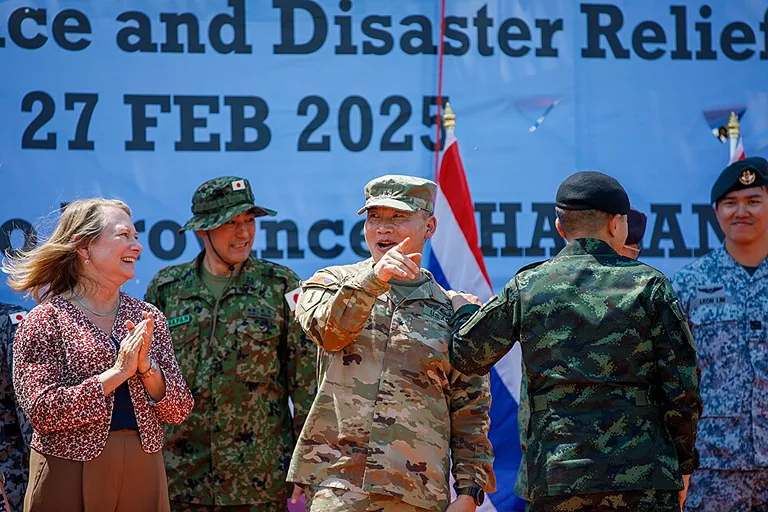
India’s HADR strategy is gaining greater reach through its partnership with the Quad, comprising India, the United States, Japan and Australia. The four countries established their HADR partnership in 2022 to improve coordination and strengthen disaster response across the Indo-Pacific.
The cooperation has increasingly moved from broad commitments toward practical coordination. Quad countries have explored information sharing, exercises and pre-positioning of essential relief supplies to ensure faster responses when disasters strike.
Credit: Wikimedia Commons
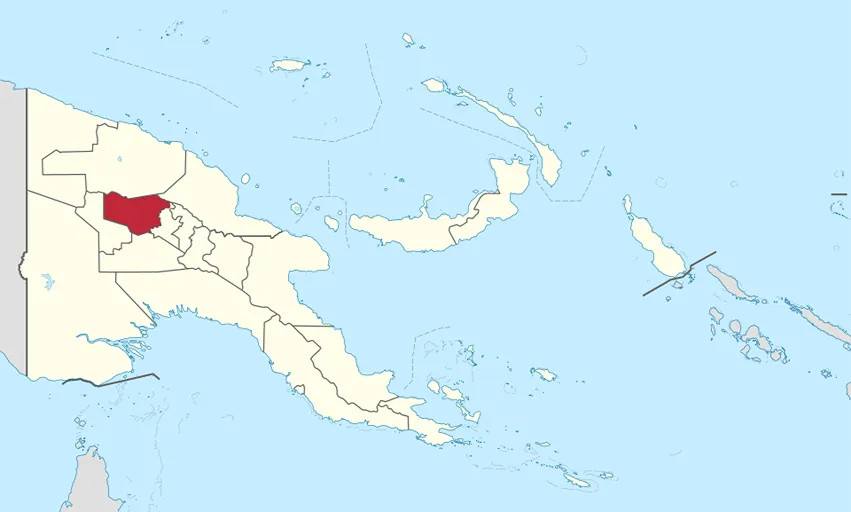
Following the 2024 Papua New Guinea landslide, the four countries collectively provided more than $5 million in humanitarian assistance.
A key development within this framework is the Quad Indo-Pacific Logistics Network, a pilot initiative focused on sharing airlift and logistics capabilities. By coordinating aircraft, relief supplies, and other resources, the network aims to overcome logistical challenges during major disasters, particularly on remote islands and in areas where roads, airports, or ports have been damaged.
For India, the initiative offers strategic advantages beyond immediate disaster relief. It connects India’s growing HADR capabilities with the substantial airlift, naval, technological and logistical resources of its Quad partners. As a result, India can strengthen its role as an important humanitarian and logistics hub in the Indian Ocean while helping build a more coordinated disaster-response architecture across the Indo-Pacific.
HADR, Maritime Awareness and Diplomacy
India’s growing HADR capability is becoming an important tool of regional diplomacy. Rapid relief deliveries, evacuations and medical assistance can build trust with Indian Ocean partners while supporting India’s broader SAGAR vision. However, India must ensure that humanitarian operations remain transparent and needs-driven. At the same time, Maritime Domain Awareness (MDA) is becoming essential for effective disaster response. Accurate information on affected areas, weather and maritime conditions helps authorities deploy ships and aircraft quickly.
The Quad’s maritime-awareness initiatives support regional monitoring, while India’s growing surveillance capabilities can strengthen search and rescue, evacuation planning and emergency coordination.
India’s HADR and Regional Influence
India’s growing partnership with Japan strengthens its HADR strategy through cooperation in maritime security, exercises, technology and Maritime Domain Awareness. Japan’s experience with earthquakes, tsunamis and disaster preparedness also adds valuable expertise to the wider Quad HADR framework.
As climate-related disasters increase, India’s ability to deliver rapid assistance could become an important measure of regional leadership. Its HADR strategy now connects relief, logistics, information and diplomacy, helping New Delhi build influence without relying solely on military power. If India can integrate these capabilities effectively, it could emerge as a leading Indo-Pacific first responder, turning humanitarian assistance into a stronger source of regional trust and strategic credibility.
What is HADR?
HADR stands for Humanitarian Assistance and Disaster Relief. It involves emergency operations that provide rescue, evacuation, medical care, relief supplies, and infrastructure support during disasters.
Why is HADR important for India?
HADR helps India protect lives while strengthening relationships with neighbouring and Indo-Pacific countries. It also demonstrates India’s logistical and maritime capabilities.
What is the Quad Indo-Pacific Logistics Network?
It is a Quad pilot initiative involving India, the United States, Japan and Australia. It seeks to use shared airlift and logistics capabilities for faster civilian disaster response.
How does Maritime Domain Awareness support HADR?
Maritime Domain Awareness provides information about activities and conditions at sea. Such information can support disaster monitoring, search and rescue, and emergency response.
Why is India important to Indo-Pacific disaster response?
India’s location in the Indian Ocean, combined with its naval, airlift, medical and logistics capabilities, allows it to respond rapidly to emergencies across the region.