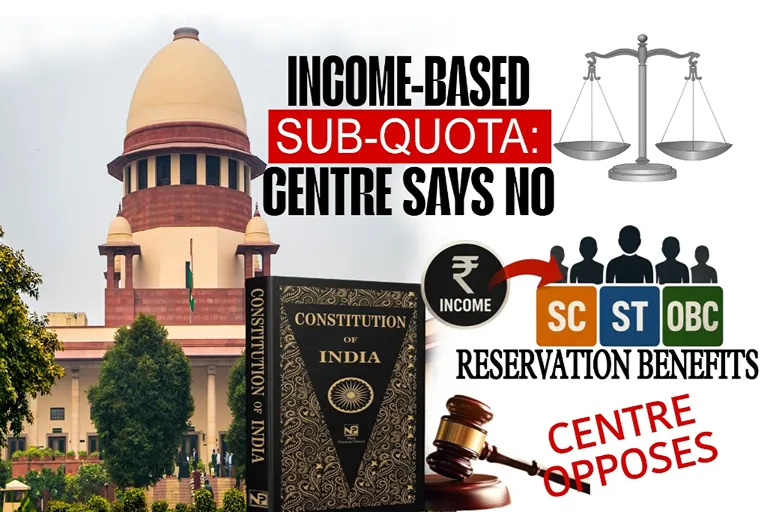

India’s reservation policy has entered another significant legal and constitutional debate. This time, the focus is Income-Based Reservation within existing SC, ST, and OBC categories. The issue has reached the Supreme Court after a petition sought an income-based sub-quota for economically weaker individuals within these reserved communities.
However, the Union government has firmly opposed the proposal. According to the Centre, reservation was created to address historical discrimination and social exclusion rather than economic hardship alone. As a result, the case has reopened a broader discussion about the constitutional purpose of affirmative action and whether economic status should influence benefits within existing reservation categories.
What Triggered the Case on Income-Based Reservation?
The latest legal challenge began after a petition was filed in the Supreme Court seeking an income-based sub-quota within reservations already available for Scheduled Castes (SC), Scheduled Tribes (ST), and Other Backward Classes (OBCs).
The petitioner argues that economically weaker members of these communities should receive greater priority than families that have become financially stronger over time. Supporters believe this would ensure that reservation benefits reach those who need them the most. Nevertheless, the proposal has immediately raised constitutional questions because India’s reservation framework has traditionally been based on social and educational backwardness rather than income.
What Does the Plea Seek?
The petition does not seek to abolish reservation. Instead, it requests the Supreme Court to consider creating an Income-Based Reservation mechanism within existing SC/ST/OBC quotas. Under this proposal, individuals with lower family incomes would receive priority while accessing reserved educational seats and government jobs.
Supporters describe the idea as a way to improve the distribution of reservation benefits. Critics, however, argue that it could fundamentally alter the constitutional basis of India’s reservation system.
Why the Centre Opposes Income-Based Reservation
The Union government has strongly opposed the petition before the Supreme Court. According to the Centre, the Constitution recognizes reservation as a remedy for historical discrimination, untouchability, caste-based exclusion, and inadequate representation. Therefore, reservation cannot be converted into a welfare scheme based primarily on financial status.
The government has argued that:
- SC, ST, and OBC reservations exist because of social and educational backwardness.
- Economic hardship alone cannot replace constitutional criteria.
- Income levels may change over time, but historical discrimination often continues across generations.
- Parliament has already created a separate framework for economically weaker sections through the EWS reservation.
The Centre maintains that introducing an income-based classification within reserved categories would alter the original constitutional objective behind affirmative action.
Why Income Remains a Contested Criterion
Economic disadvantage is undeniably important. However, constitutional experts have long distinguished poverty from social exclusion. A poor person from a socially advanced community and a poor person from a historically marginalized caste may face different challenges despite having similar incomes.
For decades, Indian courts have emphasized that reservation is intended to correct unequal representation caused by caste-based discrimination rather than simply redistribute economic opportunities. Because of this distinction, replacing social backwardness with income could create legal and constitutional complications.
Constitutional Questions Before the Supreme Court
The case raises important questions about how India’s reservation framework should balance social disadvantage and economic hardship. At the centre of the dispute is whether income can be used to determine priority within the existing SC, ST and OBC reservation system. Articles 15(4) and 16(4) allow special provisions for socially and educationally backward classes, as well as SCs and STs. The constitutional framework therefore places social and educational backwardness at the heart of these provisions. The petition raises the further question of whether an income-based sub-classification can be introduced without changing that underlying principle.
The issue is also distinct from the 10% EWS reservation created through the 103rd Constitutional Amendment. EWS reservation was introduced under Articles 15(6) and 16(6) and operates separately from the existing SC, ST and OBC reservation provisions. The Supreme Court upheld the constitutional validity of the EWS framework in 2022. The present case could therefore require the Court to examine whether economic criteria can be used within existing reserved categories and, if so, what constitutional limits would apply. It could also clarify the respective roles of the judiciary, Parliament and the executive in changing the structure of reservation benefits.
Income vs Caste: A Debate Beyond the Courtroom
The discussion extends far beyond legal arguments. Supporters of Income-Based Reservation believe the policy could ensure that poorer families within reserved communities receive greater opportunities.
Meanwhile, opponents argue that financial progress does not erase centuries of discrimination. They believe caste-based barriers continue even after economic conditions improve. Consequently, the debate reflects two competing visions of social justice. One prioritizes present-day economic need. The other emphasizes historical disadvantage and equal representation.
Who Could Be Affected?
If any signAny change arising from the case could affect how reservation benefits are allocated within the SC, ST and OBC categories, particularly in government jobs and admissions to educational institutions. The impact would depend on whether an income-based criterion is eventually permitted and how it is implemented.
For now, however, the existing reservation framework remains in place. The Supreme Court’s proceedings could determine whether such a criterion can be introduced within these categories under the constitutional framework.
What Happens Next?
The immediate focus will be on the Supreme Court proceedings and the arguments presented by the parties. The Court may first determine whether the petitions raise grounds that require further examination before considering the wider constitutional questions.
The case could also require the Court to examine existing precedents on the creamy-layer principle and the extent to which economic criteria can be applied within different reservation categories. Any clarification from the Court could become relevant to future cases involving the eligibility and distribution of reservation benefits.
Until the Court issues further directions or a final ruling, the existing reservation rules will continue to apply.
Conclusion
The debate over Income-Based Reservation is not merely about income levels. Instead, it concerns the constitutional philosophy behind India’s reservation system. The Centre believes reservation exists to correct historical social injustice rather than economic inequality alone. The petition, however, argues that financial vulnerability within reserved communities deserves greater consideration.
Ultimately, the Supreme Court’s decision will determine whether India’s constitutional approach to affirmative action remains unchanged or enters a new phase of legal interpretation. Until then, the debate is likely to remain at the centre of both legal and political discourse.
FAQ
What is Income-Based Reservation?
Income-Based Reservation refers to a proposal that reservation benefits should be prioritized according to economic status rather than solely social and educational backwardness.
Why has the Centre opposed the proposal?
The Centre argues that the Constitution provides reservation to address historical social discrimination and inadequate representation, not economic hardship alone.
Does the petition seek to end reservation?
No. The petition seeks an income-based sub-quota within existing SC, ST, and OBC reservation categories.
Is there already an economic reservation in India?
Yes. The Constitution provides a 10% reservation for Economically Weaker Sections (EWS), which applies to eligible groups outside the existing SC, ST, and OBC reservation framework.
Has the reservation policy changed?
No. The Supreme Court is considering the petition, and the existing reservation system remains unchanged.