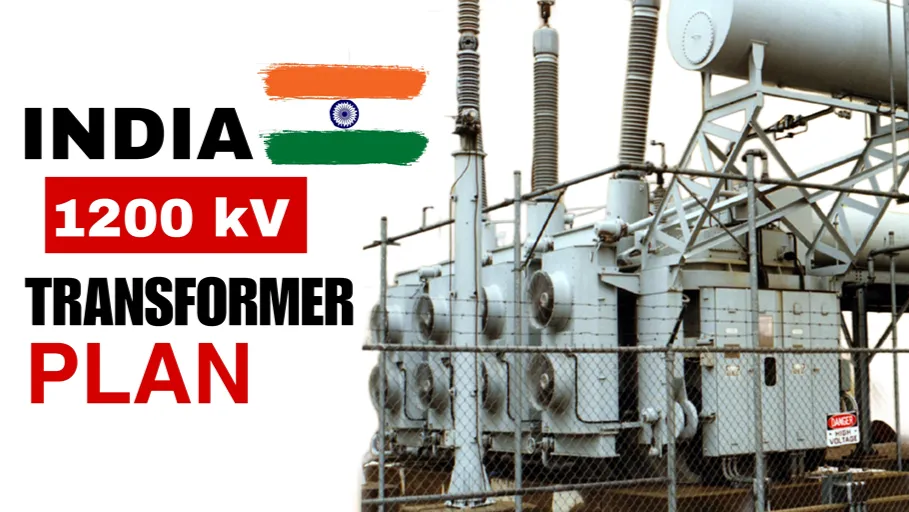
India’s 1200 kV Transformer: A Historic Power Transmission Breakthrough Strengthening India’s Energy Future

India’s power sector is entering a new era where electricity demand is rising faster than ever before. From expanding industries and electric vehicles to renewable energy projects spread across remote regions, the country needs a transmission network capable of moving massive amounts of electricity efficiently.
The development of the India 1200 kV Transformer represents one of the most significant milestones in this direction. This ultra-high voltage technology has the potential to transform how India transports electricity across long distances, reducing losses and creating a stronger national power network.
Developed with indigenous engineering capabilities, the India 1200 kV Transformer highlights India’s growing expertise in advanced electrical infrastructure and reflects the country’s ambition to become self-reliant in critical power technologies.
What is India’s 1200 kV Transformer?
A transformer is one of the most important components of an electricity transmission system. Its main function is to increase or decrease voltage levels so electricity can travel efficiently from power generation plants to consumers. The India 1200 kV Transformer belongs to the category of Ultra High Voltage Alternating Current (UHVAC) equipment. Operating at approximately 1.2 million volts, it represents one of the highest levels of transmission technology developed for large-scale electricity transfer.
The transformer developed by Bharat Heavy Electricals Limited (BHEL) was designed as a 333 MVA, 1150/400/33 kV single-phase auto transformer and installed at the 1200 kV National Test Station in Bina, Madhya Pradesh, established by Power Grid Corporation of India Limited (POWERGRID).
Key Specifications of India’s 1200 kV Transformer
| Feature | Details |
|---|---|
| Technology | Ultra High Voltage Alternating Current (UHVAC) |
| Voltage Class | 1200 kV |
| Capacity | 333 MVA |
| Transformer Type | Single-phase Auto Transformer |
| Voltage Ratio | 1150/400/33 kV |
| Developer | Bharat Heavy Electricals Limited (BHEL) |
| Manufacturing Facility | BHEL Bhopal |
| Testing Facility | 1200 kV National Test Station, Bina, Madhya Pradesh |
The India 1200 kV Transformer is not simply an upgrade in voltage capacity; it represents a major advancement in designing, manufacturing, and testing equipment capable of handling extreme electrical conditions.
Why Does India Need 1200 kV Transmission Technology?
India’s electricity demand is increasing due to rapid economic growth, urban expansion, and industrial development. However, electricity generation and electricity consumption are often located far apart. For example:
- Solar energy projects are concentrated in states like Rajasthan and Gujarat.
- Wind power generation is expanding in coastal regions.
- Large power plants are often located away from major cities.
Moving this electricity efficiently requires a powerful transmission system. The India 1200 kV Transformer can support future ultra-high voltage transmission corridors that allow bulk electricity transfer with reduced losses. According to the Ministry of Power, 1200 kV UHVAC technology can help transmit approximately 6000 MW of power per circuit while improving land-use efficiency for transmission infrastructure.
How India’s 1200 kV Transformer Can Help the Country
The India 1200 kV Transformer is more than just a technological advancement—it has the potential to reshape the country’s entire electricity transmission network. By enabling the movement of large volumes of power more efficiently, it can support India’s growing energy demand while making the national grid stronger, smarter, and more resilient.
Improving Long-Distance Electricity Transmission
One of the biggest advantages of the India 1200 kV Transformer is its ability to support high-capacity electricity movement over very long distances. Traditional transmission systems lose energy because electrical resistance creates heat during transmission. Higher voltage systems reduce current flow for the same amount of power transfer, which helps lower transmission losses. For a country as geographically large as India, this technology can improve connectivity between power-producing regions and high-demand areas.
Supporting Renewable Energy Growth
India has set ambitious renewable energy goals, but renewable projects are often located far from population centres. Large-scale solar parks and wind farms require reliable transmission networks to deliver electricity to cities and industries. The India 1200 kV Transformer could become an important part of future renewable energy corridors by enabling efficient transfer of clean electricity. This will become increasingly important as India expands:
- Solar power capacity
- Wind energy projects
- Green hydrogen production
- Electric vehicle infrastructure
Strengthening National Energy Security
Energy security depends not only on producing electricity but also on the ability to distribute it efficiently. A stronger transmission network allows different regions to share electricity during shortages or emergencies. The India 1200 kV Transformer can contribute to creating a more flexible and reliable national electricity grid.
Role of BHEL in the India 1200 kV Transformer Project
Bharat Heavy Electricals Limited (BHEL) played a crucial role in developing this advanced technology. The company used its in-house research and engineering capabilities to design and manufacture the transformer at its Bhopal facility. According to BHEL, the project required specialised manufacturing processes and advanced testing systems because ultra-high voltage equipment must withstand extreme electrical stress. BHEL’s involvement is significant because ultra-high voltage transformer technology requires highly specialised expertise.
Developing such equipment domestically reduces dependence on imported technology and strengthens India’s manufacturing ecosystem. The company has previously worked on high-voltage transmission equipment, including transformers, reactors, and other systems required for extra-high voltage networks. The India 1200 kV Transformer demonstrates how Indian engineering companies are moving toward advanced infrastructure manufacturing.
Importance of Bina National Test Station
The 1200 kV National Test Station at Bina, Madhya Pradesh, plays an important role in validating ultra-high voltage technology. POWERGRID established the facility to test and evaluate 1200 kV equipment before large-scale commercial deployment. The station helps engineers understand operational challenges, improve designs, and develop standards for future transmission networks. The Bina facility is important because ultra-high voltage transmission requires extensive testing before being introduced into a nationwide electricity network.
Challenges Before Large-Scale Deployment
Despite its importance, the India 1200 kV Transformer technology faces several challenges before becoming widely used.
High Infrastructure Investment
Building a 1200 kV transmission network requires enormous investment in:
- Transmission towers
- Substations
- Safety systems
- Land acquisition
- Maintenance infrastructure
The cost of creating ultra-high voltage corridors is significantly higher than conventional transmission systems.
Technical Complexity
Operating at 1200 kV requires advanced engineering solutions. Challenges include:
- Managing electrical insulation
- Preventing equipment failures
- Maintaining grid stability
- Protecting systems from lightning and environmental factors
Even minor design issues can create major risks at such high voltage levels.
Need for Skilled Workforce
Ultra-high voltage networks require engineers and technicians with specialised knowledge. India will need continued investment in training, research, and development to operate and maintain these advanced systems.
Why India’s 1200 kV Transformer Achievement Matters
The India 1200 kV Transformer is more than a technological achievement; it represents India’s changing position in the global power infrastructure sector. Historically, advanced ultra-high voltage equipment was dominated by a limited number of international manufacturers. Developing this technology domestically shows India’s ability to design and manufacture complex electrical systems. This achievement supports several national priorities:
- Energy independence
- Domestic manufacturing
- Renewable energy integration
- Future electricity demand management
As India moves toward becoming a major global economy, reliable electricity infrastructure will play a central role. The India 1200 kV Transformer provides a foundation for building a future-ready power transmission system capable of supporting decades of growth.
Will India Build a 1200 kV Power Network?
India’s transition toward ultra-high voltage transmission will depend on future electricity demand, economic feasibility, and grid planning. While widespread commercial deployment may take time, the successful development and testing of 1200 kV technology provides India with valuable experience. The country has already expanded from 400 kV systems to 765 kV transmission networks. The next step toward 1200 kV demonstrates India’s long-term vision for a stronger and more efficient electricity grid.
What is India’s 1200 kV Transformer?
The India 1200 kV Transformer is an ultra-high voltage transformer designed to support large-scale electricity transmission with reduced losses over long distances.
Who developed India’s 1200 kV Transformer?
The transformer was developed by Bharat Heavy Electricals Limited (BHEL) using indigenous research and manufacturing capabilities.
Where is the 1200 kV Transformer tested?
The transformer is associated with the 1200 kV National Test Station at Bina, Madhya Pradesh, developed by POWERGRID for testing ultra-high voltage systems.
How will this technology benefit India?
It can improve long-distance power transmission, reduce energy losses, support renewable energy integration, and strengthen national grid reliability.
Is India the only country developing 1200 kV technology?
Several countries have explored ultra-high voltage transmission, but developing indigenous 1200 kV equipment places India among nations with advanced transmission capabilities.
By Sahil Koul | National Affairs Analyst covering Indian politics, governance, public policy, and major developments shaping the nation.