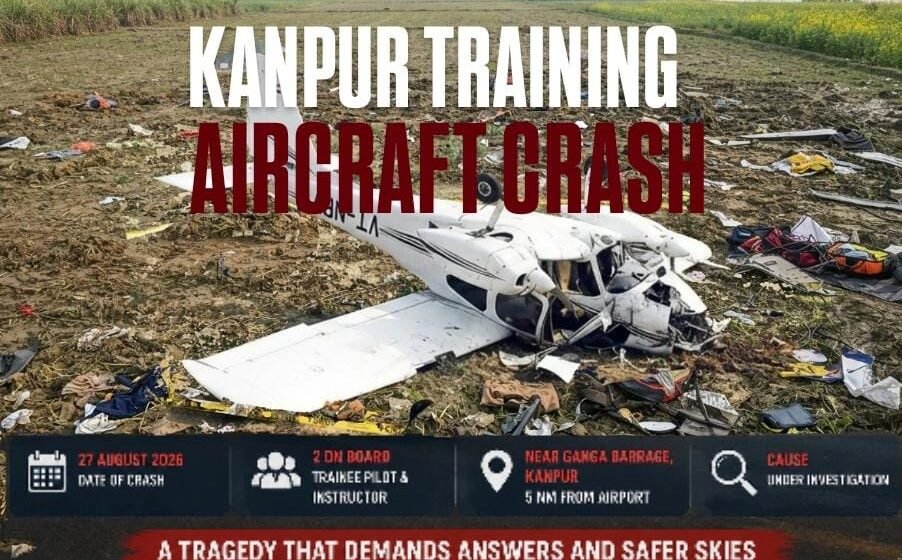

A routine training flight turned fatal in Kanpur on Thursday after a Tecnam P2006T aircraft crashed near the Ganga Barrage, killing both people on board. The accident has once again brought the safety of India’s pilot-training ecosystem into focus, particularly the risks faced by student pilots and instructors during early stages of flight training.
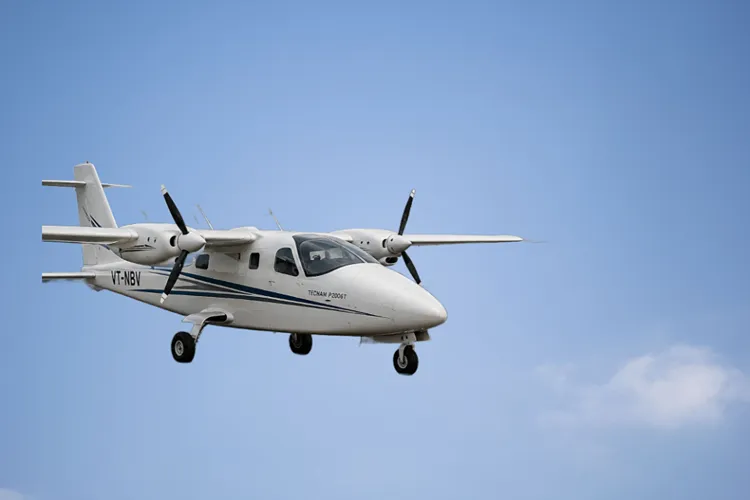
The aircraft, registered VT-NBV, was operated by Garg Aviation Ltd. and was conducting a training sortie from Kanpur Civil Airport. It came down in the local flying area, around 5 nautical miles from the airport, near the Ganga Barrage.
The immediate facts are clear, but the cause is not. The Kanpur training aircraft crash is being investigated, and there is currently no established basis to attribute it to engine failure, pilot error, maintenance problems, weather or any other particular factor. Yet the accident raises a wider question.
India is rapidly expanding its aviation infrastructure and requires thousands of new pilots to support the growth of its commercial aviation sector. That makes the safety of basic and advanced flying training more important than ever. The Kanpur training aircraft crash therefore deserves examination not only as an individual accident, but also within India’s longer history of training-aircraft accidents.
What Happened in the Kanpur Crash?
The accident occurred on 27 August 2026 during a training flight in the local flying area of Kanpur Civil Airport. The Tecnam P2006T, registration VT-NBV, was being operated by Garg Aviation Ltd., a flying-training organisation. The aircraft crashed near the Ganga Barrage, approximately five nautical miles from the airport. Two occupants were aboard: a trainee pilot and an instructor. Both died in the accident. The location is significant from a training perspective because local flying areas are routinely used for exercises designed to develop a student’s basic flying skills. Such sorties can involve take-offs, landings, turns, climbs, descents, circuit work and emergency-response exercises, depending on the stage of training.
However, the fact that the aircraft was conducting a training sortie does not by itself indicate what caused the accident. The Directorate General of Civil Aviation (DGCA) has initiated regulatory oversight, while the Aircraft Accident Investigation Bureau has been notified for a detailed investigation. Investigators will need to establish the aircraft’s flight path, altitude, speed, control inputs, weather conditions, maintenance history, operational procedures and communications before drawing conclusions.
India’s Troubled History of Training-Aircraft Accidents
The Kanpur training aircraft crash is not an isolated reminder of the risks involved in pilot training. India has experienced training-aircraft accidents involving both military and civilian operators over several decades.
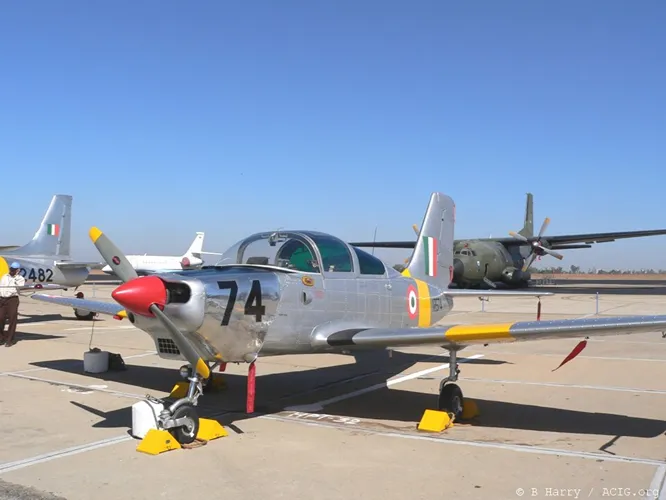
One of the most important chapters in that history involves the Hindustan Aeronautics Limited HPT-32 Deepak, which served as a basic trainer for the Indian Air Force. The aircraft was used to introduce trainee pilots to fundamental flying skills, but a series of accidents raised serious concerns about its reliability and operational safety. The HPT-32 eventually became one of India’s most prominent examples of the difficulties involved in maintaining an ageing training fleet. Problems associated with its engine and fuel system were among the concerns that emerged during its service life. Following repeated accidents and safety concerns, the aircraft was eventually grounded in 2009.
Its withdrawal demonstrated a fundamental lesson: a training aircraft cannot be judged only by whether it remains technically operational. It must provide a sufficiently reliable and predictable platform for pilots who are still developing the skills required to recognise and manage abnormal situations. India subsequently moved towards the Pilatus PC-7 Mk II for basic flying training. The aircraft began entering IAF service in 2013 and represented a major modernisation of the country’s basic training fleet. But newer aircraft did not mean the end of accidents.
Training variants of the Hawk, Kiran and PC-7 Mk II have all been involved in accidents during India’s military flying-training history. Some pilots survived by ejecting, while other accidents proved fatal. The experience demonstrates that training accidents cannot be reduced to a single question of aircraft age.
Major training-aircraft crashes and accidents in India
| Year | Location | Aircraft | Operator/Training organisation | Key details |
|---|---|---|---|---|
| 1990s | Various locations | HPT-32 Deepak | Indian Air Force | The HPT-32 became associated with several training accidents and was eventually grounded because of safety concerns. |
| 2000s | Various IAF bases | HPT-32 Deepak | Indian Air Force | Multiple accidents involving the basic trainer occurred during the decade, contributing to the aircraft’s declining availability. |
| 2009 | Hyderabad | HPT-32 | IAF | A training aircraft crashed during a sortie, adding to concerns surrounding the ageing trainer fleet. |
| 2011 | Near Hyderabad | HPT-32 | IAF | Another crash involving the aircraft highlighted persistent safety and serviceability problems. |
| 2012 | Various locations | Kiran | Indian Air Force | The HJT-16 Kiran, used for advanced jet training, was involved in several accidents during its operational career. |
| 2013 | Dindigul, Tamil Nadu | Hawk | IAF | A Hawk advanced trainer crashed during a training sortie; both pilots ejected safely. |
| 2014 | Hyderabad | Pilatus PC-7 Mk II | IAF | A basic trainer crashed during a routine training sortie, killing both occupants. |
| 2015 | Various locations | Kiran/Hawk | IAF | Further training accidents involving advanced trainers occurred during the decade. |
| 2018 | Near Hyderabad | Kiran | IAF | A Kiran trainer crashed during a training sortie; the pilot ejected safely. |
| 2019 | Bengaluru | Surya Kiran Hawk | IAF | A Surya Kiran aerobatic team aircraft crashed during rehearsals for Aero India; the pilot was killed. |
| 2020 | Hyderabad | Hawk | IAF | A Hawk trainer crashed during a routine training sortie; the pilots ejected safely. |
| 2022 | Midnapore, West Bengal | Hawk | IAF | A Hawk trainer crashed during a training sortie; both pilots ejected. |
| 2023 | Sambalpur, Odisha | Hawk | IAF | A Hawk aircraft crashed during a training sortie; both pilots ejected safely. |
| 2023 | Telangana | Pilatus PC-7 Mk II | IAF | A trainer aircraft crashed during a routine sortie, killing the instructor and trainee pilot. |
| 2025–26 | Various locations | Trainers | IAF/civilian operators | Training-aircraft incidents continued to draw attention to pilot training safety, aircraft serviceability and flying-school standards. |
The civilian side of aviation presents a different but equally important challenge. Flying-training organisations frequently use light aircraft such as the Cessna 152, Cessna 172, Diamond DA40 and other single- or twin-engine trainers. Such aircraft are designed for training, but their relatively small size and the nature of student flying mean that accidents can have severe consequences.
The history also shows why simply producing a list of crashes can be misleading. Military and civilian training operations have different aircraft, operating environments, pilot-selection systems, training syllabi, maintenance structures and emergency procedures. A crash involving a light civilian trainer cannot automatically be compared with an accident involving a military jet trainer. The better question is whether repeated accidents reveal systemic weaknesses that can be corrected.
Kanpur Crash and the Safety of India’s Future Pilots
The most important implication of the Kanpur training aircraft crash is not that India’s pilot-training system is inherently unsafe. It is that the rapid expansion of aviation makes rigorous safety oversight increasingly important. India needs a large pipeline of trained pilots. Airlines are expanding fleets, airports are being developed beyond the largest metropolitan centres and flying-training infrastructure has expanded in response to rising demand. Every additional training aircraft, flight school and trainee represents another part of that growing ecosystem. That expansion creates pressure on several fronts.
The first is aircraft availability and maintenance. Training aircraft typically accumulate a large number of flight hours because they are used repeatedly for instructional sorties. Frequent cycles of take-off, landing and manoeuvring can place substantial demands on engines, airframes and components. Preventive maintenance and accurate recording of defects therefore become critical.
The second is instructor quality and workload. An instructor is not simply another pilot sitting beside a student. The instructor must monitor the trainee, anticipate mistakes, intervene when necessary and teach the student to respond to abnormal situations. Training organisations therefore need experienced instructors and adequate supervision.
The third is student preparation. A trainee pilot is still learning how to recognise developing problems. Training must therefore prepare students not only to fly an aircraft under normal conditions but also to identify and respond to emergencies.
The fourth is operational discipline. Weather assessment, local-area procedures, aircraft dispatch, fuel planning, communication and flight monitoring can all influence the safety of a training sortie. Small weaknesses may appear insignificant individually but can become dangerous when combined.
This is where the Kanpur training aircraft crash should be examined critically. Investigators should determine not simply what happened during the final moments of the flight, but whether any preceding organisational or operational factors contributed to the accident. At the same time, it would be irresponsible to declare a maintenance failure, pilot error or technical defect without evidence. Aviation investigations frequently overturn early assumptions. There is also a broader issue of accident learning. The purpose of an investigation should not end with identifying the immediate cause. If investigators discover a recurring technical, procedural or training weakness, that finding should lead to changes across the wider training sector.
This is particularly important as India attempts to become a larger global aviation market. More pilots will require more training aircraft, more instructors and more flying hours. Safety systems must grow at least as quickly as capacity. The Kanpur training aircraft crash should therefore prompt flying schools and regulators to examine whether existing safety practices are keeping pace with the expansion of pilot training.
What happened in the Kanpur training aircraft crash?
A Tecnam P2006T twin-engine aircraft crashed near Ganga Barrage in Kanpur on 27 August 2026 while conducting a pilot-training flight.
How many people died in the Kanpur aircraft crash?
Two people—a trainee pilot and an instructor—were on board. Both sustained fatal injuries.
Which aircraft was involved?
The aircraft was a Tecnam P2006T, registered VT-NBV and operated by Garg Aviation Ltd., Kanpur.
What caused the Kanpur training aircraft crash?
The cause has not yet been established. The AAIB investigation will determine the circumstances and cause.
Who is investigating the crash?
The Aircraft Accident Investigation Bureau (AAIB) is undertaking the detailed investigation, while the DGCA has deployed a three-member team for regulatory oversight and coordination.